
Application protection that knows who is asking.
A web application firewall and application delivery controller in one appliance — with AI judgment, client identity that survives IP rotation, and a full local traffic manager.
Built for the problems WAFs still have
Attackers rotate through proxy pools, disguise payloads and automate everything. Defenders are left tuning rules that miss new attacks or block real users.
Zero-day attacks
Obfuscated payloads slip past signature-only protection.
Outpost: a positive security model rejects anything the app doesn’t accept, with multi-pass evasion decoding.
False positives
Teams loosen policies until they protect nothing.
Outpost: AI scores the risk of breaking a real user before anything is blocked.
Rotating IP addresses
Attackers spread requests across proxy pools to dodge rate limits.
Outpost: detects a cluster of IP addresses acting as one client and rate-limits the whole cluster as one.
Shared addresses
Thousands of mobile users share one carrier NAT address, so IP-based limits throttle them all together.
Outpost: rate limits key on JA4 fingerprint plus address, so users behind one NAT are never confused.
IDOR abuse
Attackers change object IDs to reach other users’ data, with requests that look perfectly valid.
Outpost: advanced anomaly detection identifies IDOR abuse and exploitation.
Poisoned learning
Learning WAFs slowly teach themselves to allow whatever attackers send often enough.
Outpost: learns only from mature baselines across many clients, and never auto-accepts a baseline judged poisoned.
Risky policy changes
Tightening a rule in production can break real users without warning.
Outpost: new rules run in staging before they block, and applied changes are watched with one-click rollback.
WAF outages
When the WAF fails, the application goes down with it.
Outpost: a failsafe circuit breaker applies your fail-open or fail-closed choice, and HA pairs fail over in under 4 seconds.
Separate products
WAF, load balancer and analytics each see part of the picture.
Outpost: WAF, traffic management and analytics in one appliance.
Key benefits
Stop known and unknown attacks
A positive security model rejects anything outside what the application accepts — whether or not a signature has seen it.
Fewer false positives
AI scores the risk that blocking a request would break a real user before a rule is tightened.
Identify actors, not addresses
JA4 fingerprints, accounts and sessions follow attackers through proxy rotation.
WAF and ADC in one
Load balancing, TLS, health monitoring and traffic policy in the same appliance.
Appliance or virtual
A purpose-built appliance pair, or the Virtual Edition on your own virtualisation platform.
Stay online
Active/standby or active/active HA, sub-4-second failover and a failsafe circuit breaker.
How a request is decided
Deterministic checks decide inline in microseconds. The AI model judges what a rule can’t express. Identity comes from the client, not the address.
Detects SQL injection, XSS, IDOR abuse, command execution, path traversal, SSRF, XXE, template injection, insecure deserialization, request smuggling and automated scanners — plus an evasion layer for encoded payloads. Every violation has its own Learn, Alarm or Block setting, and new rules start in staging.
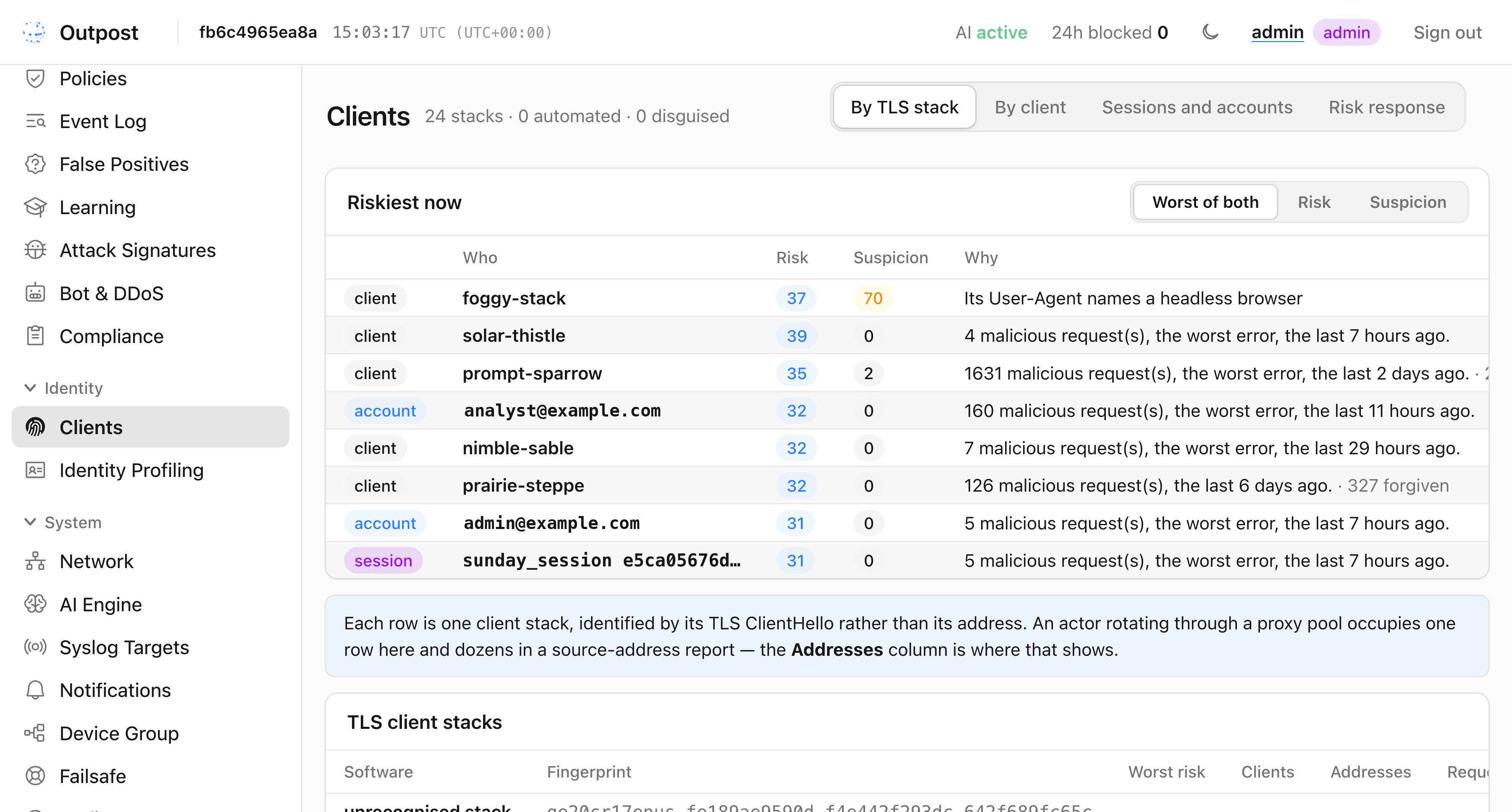
Risk follows the actor, not the address
An actor rotating through a proxy pool occupies one row here — and dozens in a source-address report.
- TLS fingerprinting (JA4) — identifies the client software, not the person, and survives address rotation.
- Risk & suspicion — scored per client, account and session, with tiered responses.
- Account & session linking — ties requests to the accounts and sessions your application already issues.
- Session awareness — follows each session end to end, so risk, anomalies and responses are judged per session, not per request.
- Cluster rate limiting — IP addresses acting as one client are grouped and rate-limited as one.
Privacy by design. Fingerprints and identity data are used only for security decisions, never for marketing or profiling. Analytics retention is configurable, 7 days by default.
Rules decide. The model judges.
For each reviewed request, the AI returns typed answers the policy combines. Blocking needs both a high attack probability and a low risk of breaking a real user.
Is this a deliberate attack?
The blocking decisionWould blocking break a real user?
False-positive suppressionWhich technique, how severe?
Reporting and triageIs the baseline poisoned?
Safe policy suggestionsCommander & Patrol
AI operator · a person approves every changeA full traffic manager, not a filter bolted on
- Virtual servers, pools, nodes and health monitors
- Declarative traffic policies and sandboxed TCL-style rules
- SSL profiles with automatic ACME certificates
- nginx import with a preview of what migrates
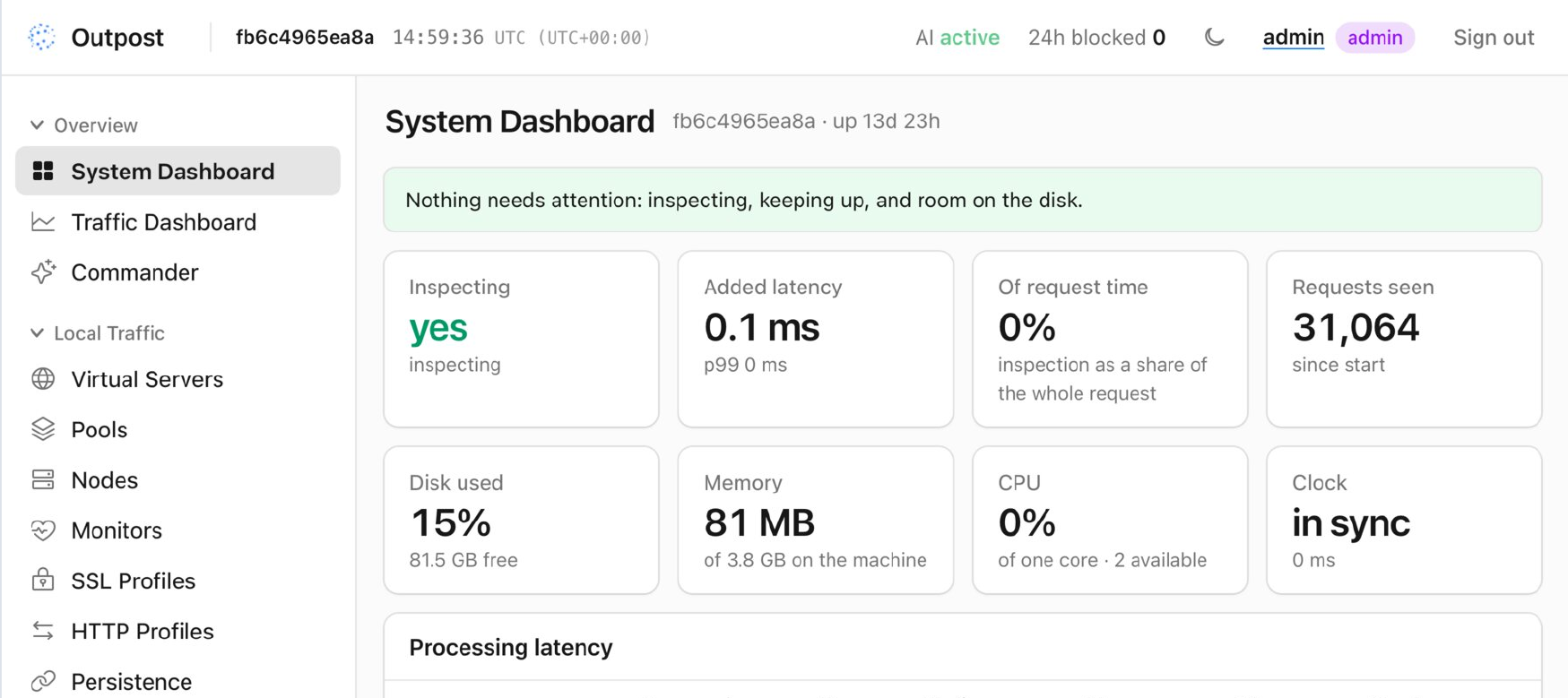
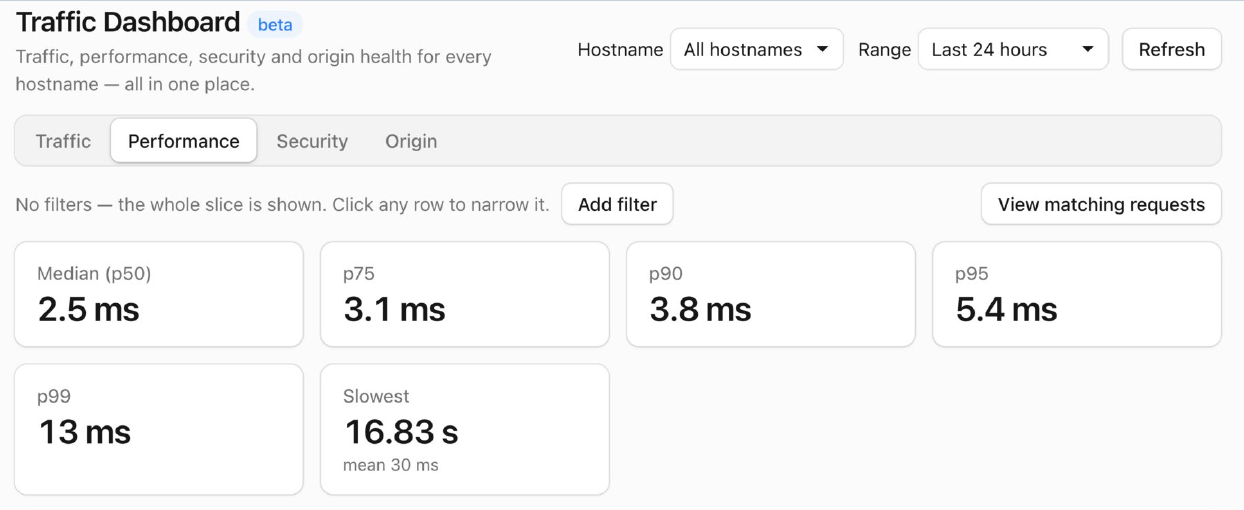
Click a hostname. See what changed.
- Traffic, performance, security and origin per hostname
- SIEM export: syslog, CEF, LEEF and JSON over UDP, TCP or TLS
- Alerts to webhooks, Slack, email and Telegram
- Admin, security, operator and viewer roles
Measured performance
Per appliance, full inspection in blocking modeDeployment options
Appliance pair
Purpose-built, software pre-installed, 1U rack mount.
Virtual Edition
Same software and features on your own x86-64 platform.
Figures measured with full WAF inspection in blocking mode, all signature sets, AI asynchronous, HTTP/1.1 keep-alive, TLS 1.3. Results in production depend on traffic mix and configuration.
See Outpost on your traffic
Book a demonstration or start an evaluation.